Reducing CHW Claim Rejections and Denials in the Community
Most CHW and social service claim rejections start with bad demographic data collected in the field. LastMile RCM's new mobile eligibility and patient creation tool stops them at the source.

Aaron Holman
Co-Founder, Partner · October 2, 2026
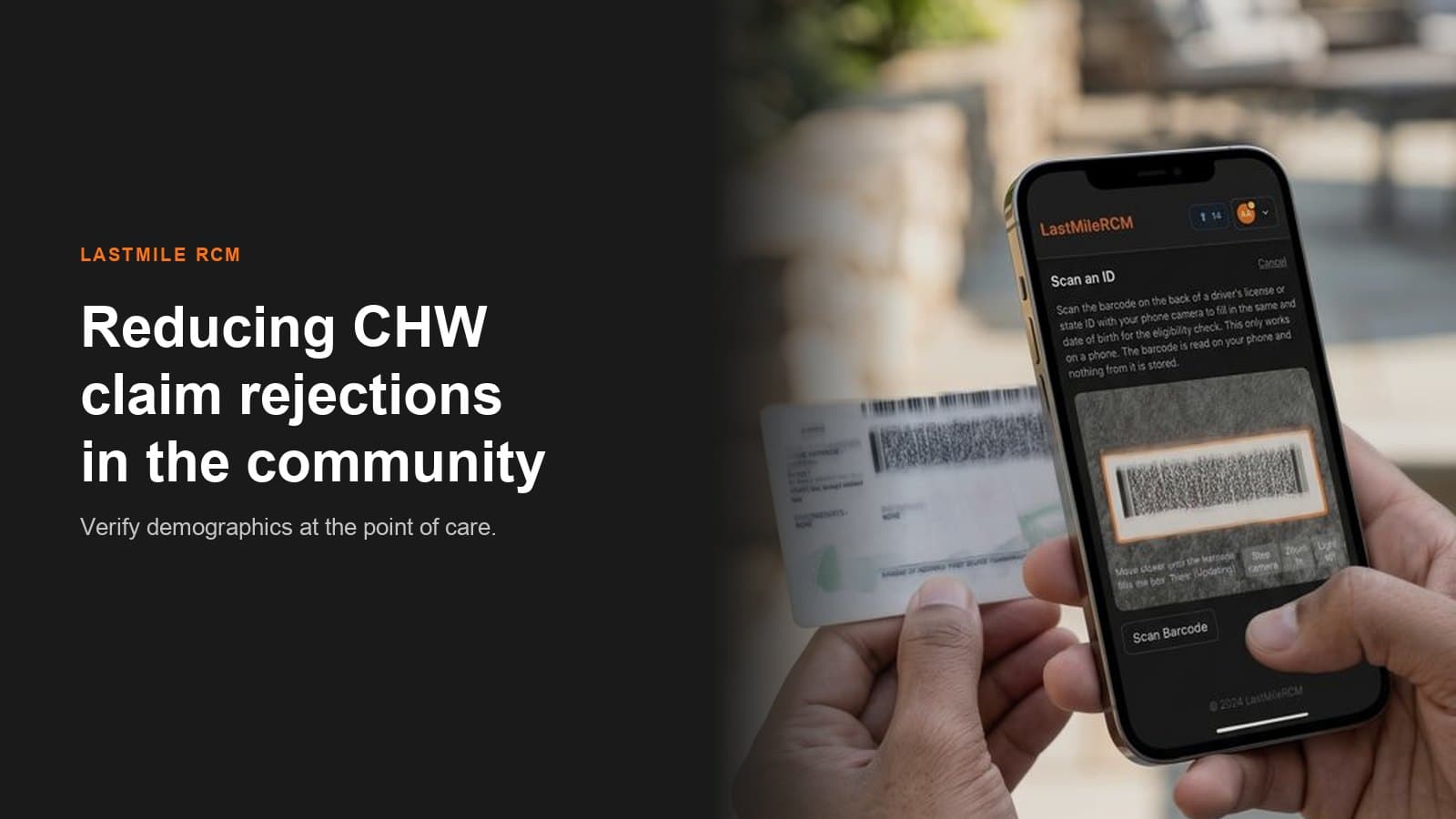
Community health worker programs, Care Managers, Housing and other Community Supports providers, and state and county social service teams send us their patient services data every day. We help turn it into claims and submit it to their contracted insurance plans. After years of working with every kind of claim, our team knows the importance of the "front" of the revenue cycle: capturing the correct patient information at the point of service delivery.
Here is how it usually goes. A CHW or a housing navigator meets someone out in the community. Maybe on a porch, in a shelter lobby, at a food bank, or in the parking lot of an apartment building. The case manager writes down a name and a date of birth, or types it into a tablet or phone from memory, and moves on to the real work of helping that person.
Weeks later, a claim is built and sent to a payer who promptly rejects it. The name on the claim is "Smith-Jones" but the payer has "Smith Jones" with no hyphen. The birth date has two digits flipped. The first name is "Mike" instead of "Michael." The Medicaid ID is off by one character. In the payer's system, that person does not exist, so the eligibility check fails and the claim is denied.
None of that is the case manager's fault. The problem is that the data was collected in a setting with no safety net, and nobody found out it was wrong until the claim came back, weeks later.
Preventing rejections and denials with community-level technology
LastMile RCM will always help you fix rejections and denials after the fact. That is a core part of the product. But the cheapest denial to work is the one you never submit, so we built a tool that stops bad demographics at the source.
It is a mobile application, built for a phone, that any CHW, care coordinator, housing navigator, or community-based worker can use anywhere they are. With it, you can:
- Check the insurance eligibility of any person, on essentially any plan, in real time
- Create a new patient record directly from a verified eligibility result
- Re-check eligibility for an existing patient before you deliver a service
Eligibility checks run across more than 3,000 insurance plans through our clearinghouse network, so it works whether the person has Medicaid managed care, a commercial plan, Medicare, or a combination.
Scan the ID, skip the typing
The piece we are most excited about is the scanner.
Open the app, tap Scan an ID, and point your phone's camera at the barcode on the back of any state-issued ID or driver's license.
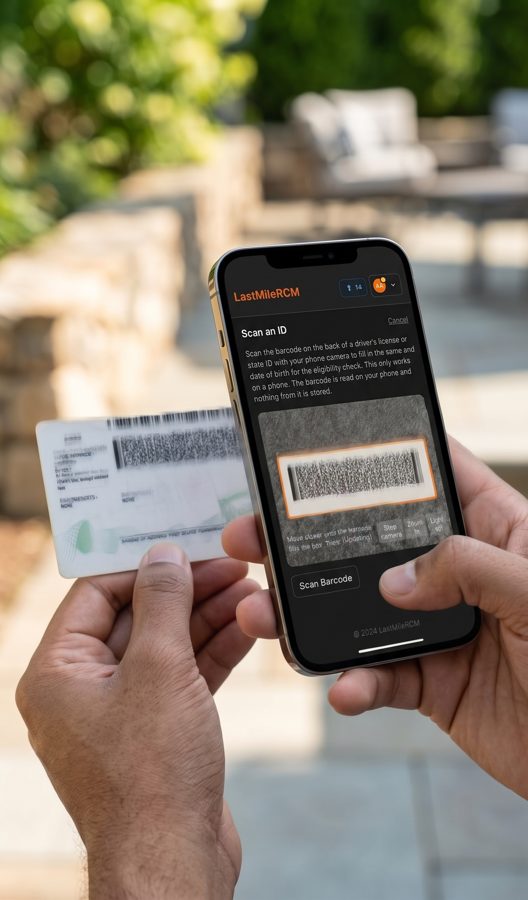
The app reads the barcode on the phone itself. Nothing from the ID is stored. In a few seconds, the person's legal last name, first name, middle initial, and date of birth are pulled directly off the card, exactly as the state has them on file.
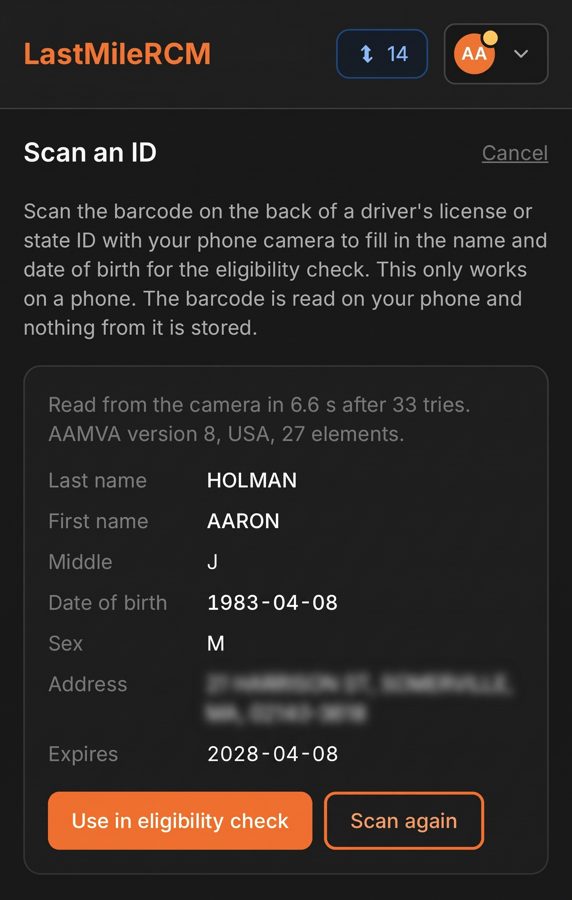
That matters more than it sounds. The name on a state ID is the legal name, which is typically pretty close to the name the insurance company has too. The date of birth is the real date of birth. No more clicking in small boxes, no chances for a typo.
From there, the case manager adds insurance payer and member ID, often by reading them straight off the insurance card in the person's hand, and taps "Use in eligibility check." The app immediately sends that person's information to their insurance company and immediately gets a response: eligible or not, the plan name, the member ID as the payer has it, plan start and end dates, and coverage details.
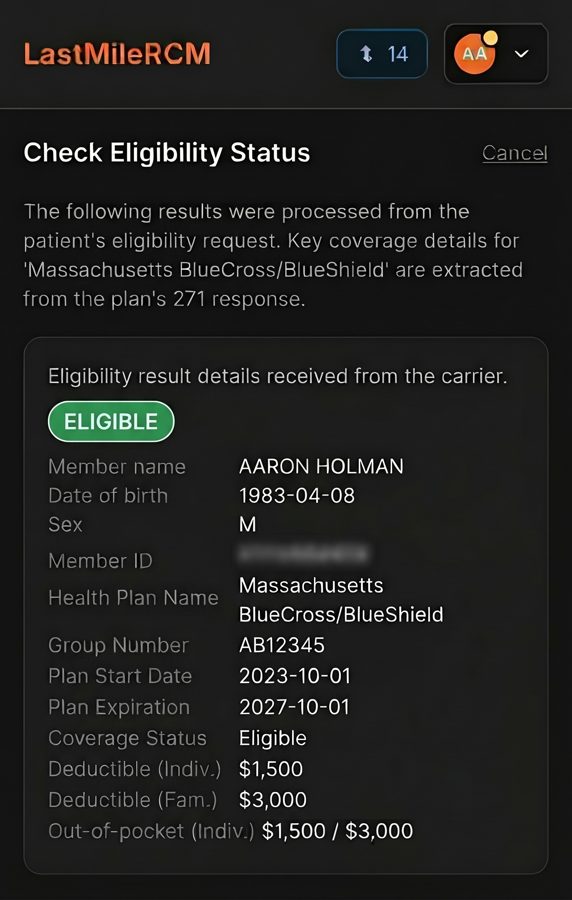
If the person does not have an ID with them, the CHW can simply type the information in while sitting face to face with them, or while on the phone with them. The eligibility check works the same way. The point is that the data gets verified against the payer at the moment it is collected, not weeks later. If it comes back as incorrect, the case manager can try again with a different spelling or a different plan name. You keep trying with the person there, so you know it's right before you leave.
Create the patient with the right data the first time
Once eligibility comes back, the CHW can create the patient record right there, with one tap.
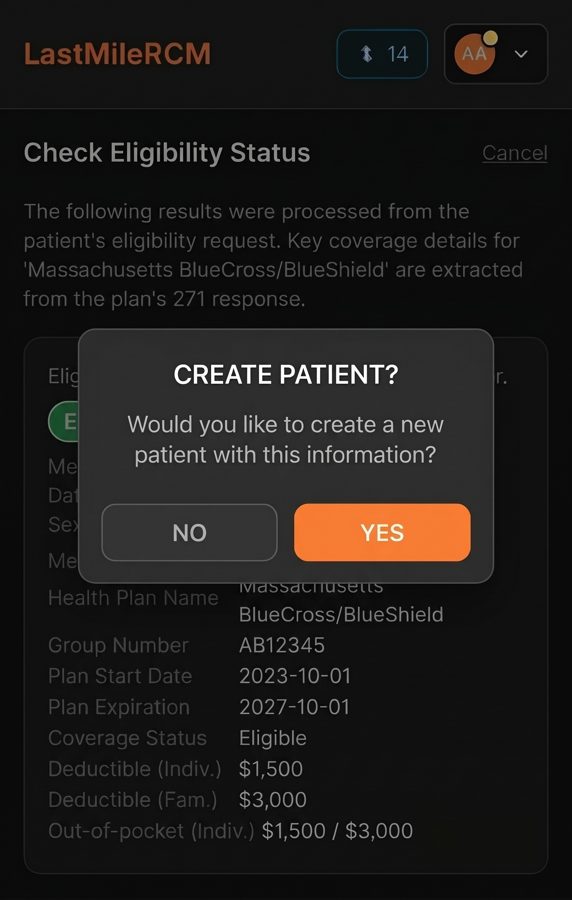
The new record is built from the demographics that just passed the payer's eligibility check. That means the name, date of birth, payer, and member ID in your system match what the payer expects before a single service is documented or a single claim is generated. Every claim for that patient going forward starts from a clean record.
What this means for your rejection and denial rates
If more than half of your CHW and social service denials come from demographic mismatches, then verifying demographics at intake is the single highest-leverage change you can make. It is also the easiest one, because it moves the work to the moment when the person is right in front of you and can confirm their own information.
A CHW or case manager with a phone can now do in thirty seconds what used to take a billing team days of back and forth: confirm who the person is, confirm they are covered, and create a record that will bill cleanly.
LastMile RCM will still be there to help you work the denials you do get. We would just rather you had fewer of them.
If you run a CHW program, an ECM or Community Supports provider, or a county team that bills for community-based services, we would like to show you how this works. Reach out to us at thehealthcolab.com.
Want to talk about this?
We publish what we learn from the work. If it applies to your organization, get in touch, or join the conversation on LinkedIn.