LastMile RCM: Turning High-Value Community Work into Revenue
Community organizations, county agencies, and CHW networks do some of the most valuable work in Medi-Cal. Under CalAIM much of it is billable. LastMile RCM closes the distance between a documented encounter and a paid claim.

Aaron Holman
Co-Founder, Partner · September 15, 2026
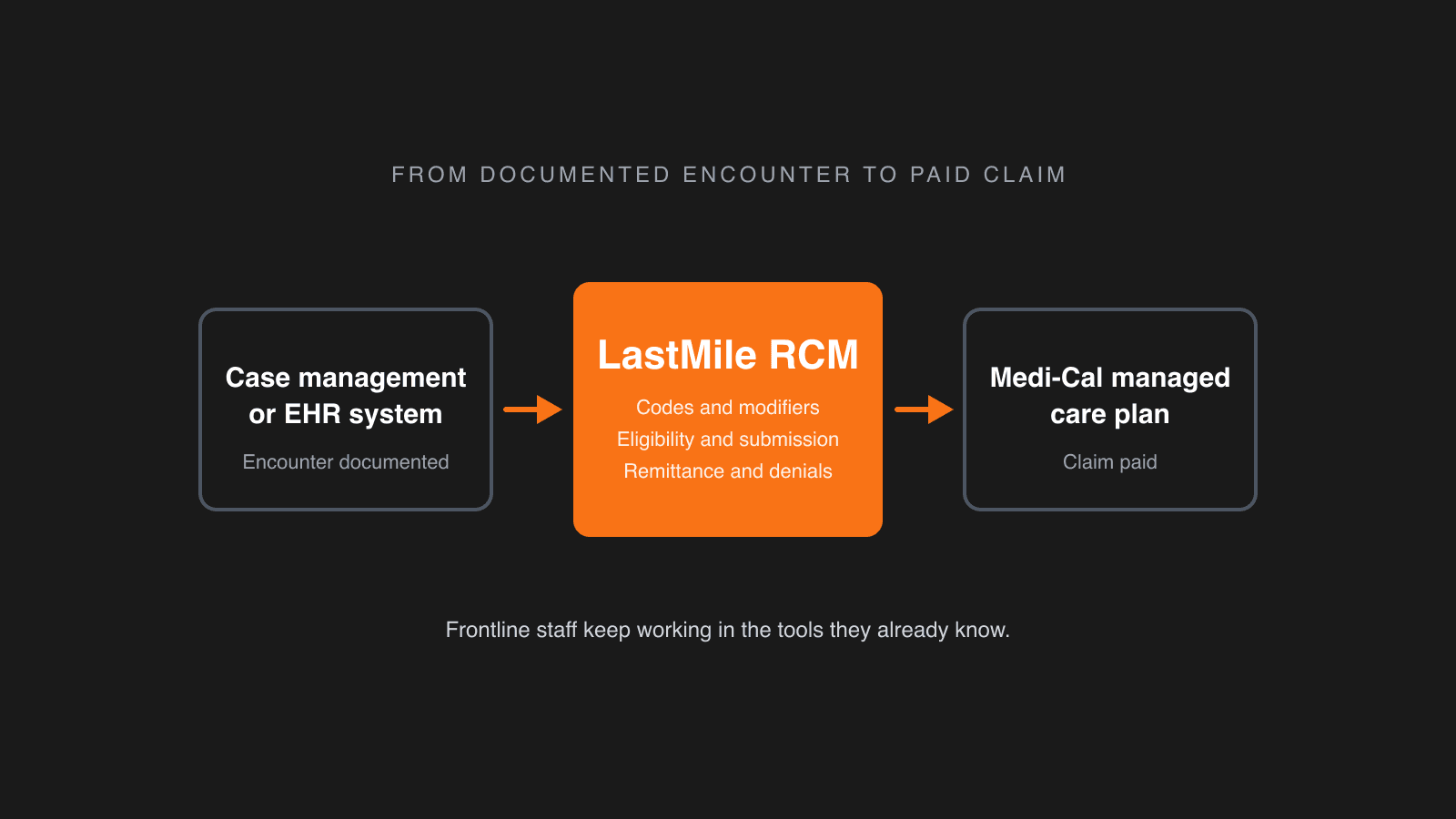
Community-based organizations, county agencies, and community health worker networks do some of the most valuable work in the Medi-Cal system. Under CalAIM, much of that work is now billable. The problem is that the organizations doing it were never built to submit claims. Their staff live in case management systems, not billing systems, and the distance between a documented encounter and a paid claim has been where the money gets lost.
LastMile RCM was built to close that distance. Today we want to share how it works and how we are putting it to use across a growing set of partners.
How the system works
LastMile sits between the systems where care is documented and the payers who reimburse for it. It takes encounter data as it already exists in a case management or electronic health record system, applies the correct procedure codes, modifiers, and diagnosis codes based on the service delivered and the staff who delivered it, and generates a clean claim. It then handles the parts that usually stall in a spreadsheet: eligibility checks, submission, remittance tracking, and denial follow-up. The organization keeps doing its work in the tools it already knows. LastMile handles the claims environment behind it.
The design principle is simple. Frontline staff should never have to learn billing to get paid for the work they already document.
Unlocking value for different clients
In Fresno, the Fresno Community Health Improvement Partnership operates as a community health worker hub, coordinating CHW services across a network of partner agencies. LastMile gives the hub a single claims environment for all of that activity, so the work performed across many organizations can be billed and reconciled in one place. Just as important, the claims data shows exactly where revenue is being held up, such as incomplete member demographics at the point of enrollment, which lets the hub fix the process rather than the symptom.
In Monterey County, the Department of Social Services is standing up Enhanced Care Management billing. County case managers already complete detailed assessments in the state eligibility system. Our team mapped those existing fields to the ECM billing codes and identified the small number of additional data points required for a compliant claim. The result is a county earning reimbursement for high-value case management it was already delivering, without building a billing department to do it.
Embedded in the systems our partners already run
The most significant development is where LastMile lives. We are working with case management and electronic medical record vendors to offer LastMile as an embedded, white-labeled solution inside their platforms. Their customers get a world-class claims environment without leaving the system they use every day, and the vendor gains a revenue cycle capability it did not have to build. These vendors are among our most valued customers because each integration brings billing to every organization on their platform at once.
What comes next
We are expanding the code sets LastMile supports, deepening our vendor integrations, and continuing to publish what we learn about the data gaps that keep community organizations from getting paid. If you run a county program, a CHW hub, or a platform that serves them, we would like to talk.
Contact Aaron Holman at aaron@thehealthcolab.com or visit lastmilercm.com.
Want to talk about this?
We publish what we learn from the work. If it applies to your organization, get in touch, or join the conversation on LinkedIn.